DRUPWB Internship Programme Completes First Cycle Across Five Countries, Reaching 65 Participants
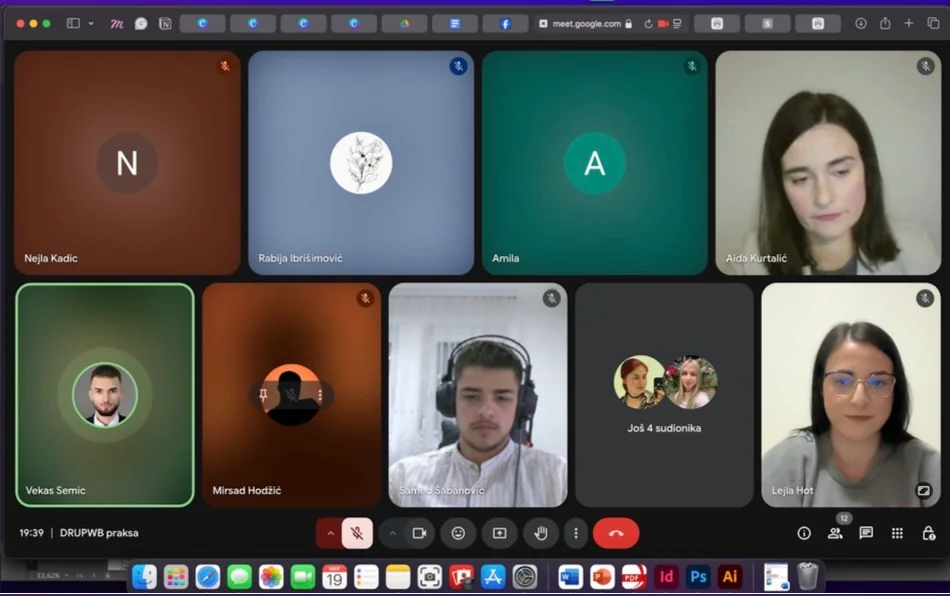
The DRUPWB project has successfully completed its first cycle of internship activities, with programmes running simultaneously in five countries — Croatia, Bosnia and Herzegovina, Germany, Lithuania, and Albania — between July and October 2025. Hosted by partner organisations across the consortium, the internships brought together 65 young people, including NEET individuals (young people not in education, employment, or training), VET students, adult learners, and aspiring entrepreneurs. All activities were designed around the project’s four-module non-formal educational curriculum, built on a STEM-based and andragogical approach.
Croatia: Hands-On Learning at Pannonia Consulting, Zagreb
In Zagreb, Pannonia Consulting hosted a one-month internship (15 September – 15 October 2025) for 10 participants, three of whom were NEET young adults aged 18–29. The group represented a diverse mix of profiles, including VET students, adult learners, and individuals exploring self-employment and freelancing.
Activities were structured around all four curriculum modules — Virtual Assistance, No-Code Programming, Self-Employment, and Starting and Running a Small Business. Participants worked through a “brief → draft → review → publish” cycle, using tools such as Canva, Trello, Google Workspace, Loom, Make/Zapier, Airtable, and Glide. Concrete outputs included a shared project inbox for a simulated client, intake forms with automations, lightweight data dashboards, one-page service flyers, and three-slide pitch decks.
The programme also included company visits to Andautonia Systems, an IT and digital solutions company, and Pučko otvoreno učilište AMC Nova Gradiška, an adult education institution — giving participants direct exposure to digital transformation in business and vocational training. Following each visit, participants produced client-ready deliverables, including web news items and workflow screencasts.
Participant Iva noted that the practical briefs pushed her to write, design, and deliver work that truly looked ready for a real client. Another participant highlighted how the no-code module helped her understand how digital pieces connect and how to explain their value without technical jargon.
The internship was covered in an article published on the Pannonia Consulting website on 20 October 2025.
Bosnia and Herzegovina: Two Parallel Programmes in Zenica and Online
Bosnia and Herzegovina contributed two distinct internship formats to the cycle, together reaching approximately 25 participants — offering both a place-based programme in Zenica and an online virtual assistance track.
Zenica (ZEDA Agency) ran a training-plus-internship programme for 13 young NEET participants (11 women, 2 men, all registered with the Employment Service) between 15 September and 15 October 2025. Ten participants held secondary education and three had completed university. None had prior business or STEM training. Following a three-day entrepreneurship and STEM training using interactive teaching, case studies, and group exercises, participants completed a one-month internship in local organisations covering finance, marketing, TV production, law, ecology, and administrative work. The programme was partially aligned with the 4-modular curriculum, with the entrepreneurship and STEM basics modules well-represented, while more advanced technical modules were harder to replicate in the available placements.
In parallel, an online internship programme (15 July – 15 August 2025) gathered approximately 12 participants — students, freelancers, and young professionals — for a four-week virtual assistantship track. Four weekly online group meetings covering content creation, video editing, digital tools, and a final review were supplemented by individual 1:1 mentoring sessions. Participants worked with Canva Pro, Google Workspace, and CapCut, producing real outputs for actual digital profiles and clients, including social media posts, blog articles, and short videos. One participant received a remote job offer from an international agency following the programme. Others enhanced their LinkedIn profiles and portfolios with materials produced during the internship.
Germany: Two Complementary Models in Freiburg and Halle (Saale)
Germany saw two separate internship approaches run by different partner organisations, together reaching 10 participants.
Outside Media & Knowledge (OMK), based in Freiburg and Emmendingen, provided individually tailored mentorships throughout October 2025 to 3 NEET-category participants (J.C., N.A., D.Z.) working in creative, marketing, and cultural sectors — including music management, social media management, digital marketing, and wellbeing coaching. Sessions of 1.5–2.5 hours each combined in-person and online formats. Mentors guided participants through visual identity, digital storytelling, social media strategy, video production, and tools such as Canva and Metricool. Networking activities included meetups with German and international microbusinesses and participation in an international event in Emmendingen with VET educators from the PROMOTE project. Two of three participants were already implementing their marketing strategies by the end of the programme; one had begun developing professional branding materials.
TVW GmbH coordinated 7 hybrid internships in Halle (Saale) between 1 August and 30 September 2025, across three host organisations: TVW GmbH (four interns), Conomic GmbH (two interns), and Körperformen Halle (one intern). The cohort consisted entirely of NEET unemployed male participants — German, Syrian, and Ukrainian nationals — with diverse educational backgrounds and, for several, significant language barriers. Work was paced at approximately four hours per week, structured around bi-weekly in-person coordination meetings and largely remote task completion. At TVW, interns followed a full content production workflow — from brief to topic research, drafting, visual creation, and publication — resulting in posts published on the company’s LinkedIn, Instagram, and Facebook pages. At Körperformen, the intern developed social-media captions and micro-campaign concepts. The two Conomic placements ended after onboarding due to non-attendance, underscoring the importance of pre-placement readiness and language-for-work preparation for future iterations.
Lithuania: Entrepreneurship and Innovation in Vilnius
In Vilnius, Innooctava hosted 10 participants — students and recent graduates aged 18–26 — between 1 August and 30 September 2025. Participants with backgrounds in creative industries, digital innovation, project management, and entrepreneurship engaged with Innooctava’s innovation projects across four areas: market research and business model development, content creation and communication, project planning, and cooperation with SMEs.
Partner organisations visited included an Innovation Agency, MB Luckris (technology and product design), MB Baltic Automation (engineering), and Aeroservisas, UAB (technology and business). Tools used included Trello, Miro, Canva, and ChatGPT, and educational methods centred on mentoring, learning by doing, peer-to-peer sharing, and weekly reflection meetings.
The internship was notable for exceeding expectations in participant engagement — several took on leadership roles, and practical tasks proved more motivating than theoretical content. Teamwork and mentoring had a measurable positive impact on confidence. Several participants expressed plans to start their own small businesses or enter startup programmes following the experience. The internship was featured in an article published by Vilnius Tech on 24 October 2025.
Albania: Digital Skills and STEM Learning in Korça
In Korça, Albania, a one-month internship (25 September – 25 October 2025) was organised for 10 young NEET participants, identified in collaboration with the Korça Employment Office and hosted at the Vocational School “Services”. The programme focused on the Virtual Assistant and No-Code Programming modules of the DRUPWB curriculum.
Participants learned to manage professional emails, prepare reports, organise calendars, create social media content, build Google Forms with automated notifications, and develop basic task-tracking dashboards. Digital tools used included ChatGPT, Google Gemini, Microsoft Copilot, Grok X, Canva, Trello, Google Sheets, Google Docs, Loom, and Airtable. Each participant created a Standard Operating Procedure for document management and developed a small personal project presented through a written report and digital presentation.
Company visits were made to Tech-Hub Korça (innovation and technology centre), National Commercial Bank BKT Korça Branch (digital systems in banking), Korça Youth Center, and a local travel agency. All outputs went through both a mentor and a peer review cycle.
Participants Sara and Fiorela both reflected on how the internship strengthened their professional confidence, improved their communication skills, and gave them the readiness to take on new challenges in education or employment.
Across All Programmes: Common Themes and Lessons
Despite the diversity of national contexts and implementation models, the DRUPWB internship cycle revealed several consistent themes. Across all 65 participants, engagement was high, with NEET individuals in particular demonstrating notable progress in digital literacy, communication, and professional confidence. Non-formal, work-based learning methods consistently outperformed classroom-based instruction in terms of motivation and skill retention. One participant secured a remote job offer with an international agency, while many others updated their professional portfolios and LinkedIn profiles with real outputs from the programme.
Shared recommendations for future iterations across all partner organisations include extending internship durations to allow deeper project development, strengthening pre-placement readiness (including digital literacy orientation and, where relevant, language-for-work preparation), expanding collaboration with local SMEs, and introducing more structured follow-up and mentoring after the internship period ends.